Rebuilding My Portfolio
Replaced a one-page static site with a content-driven site built around projects, a build log, writing and experiments.
This site, treated as a product. Built as a living record of what I'm building, testing and learning, not a static resume.
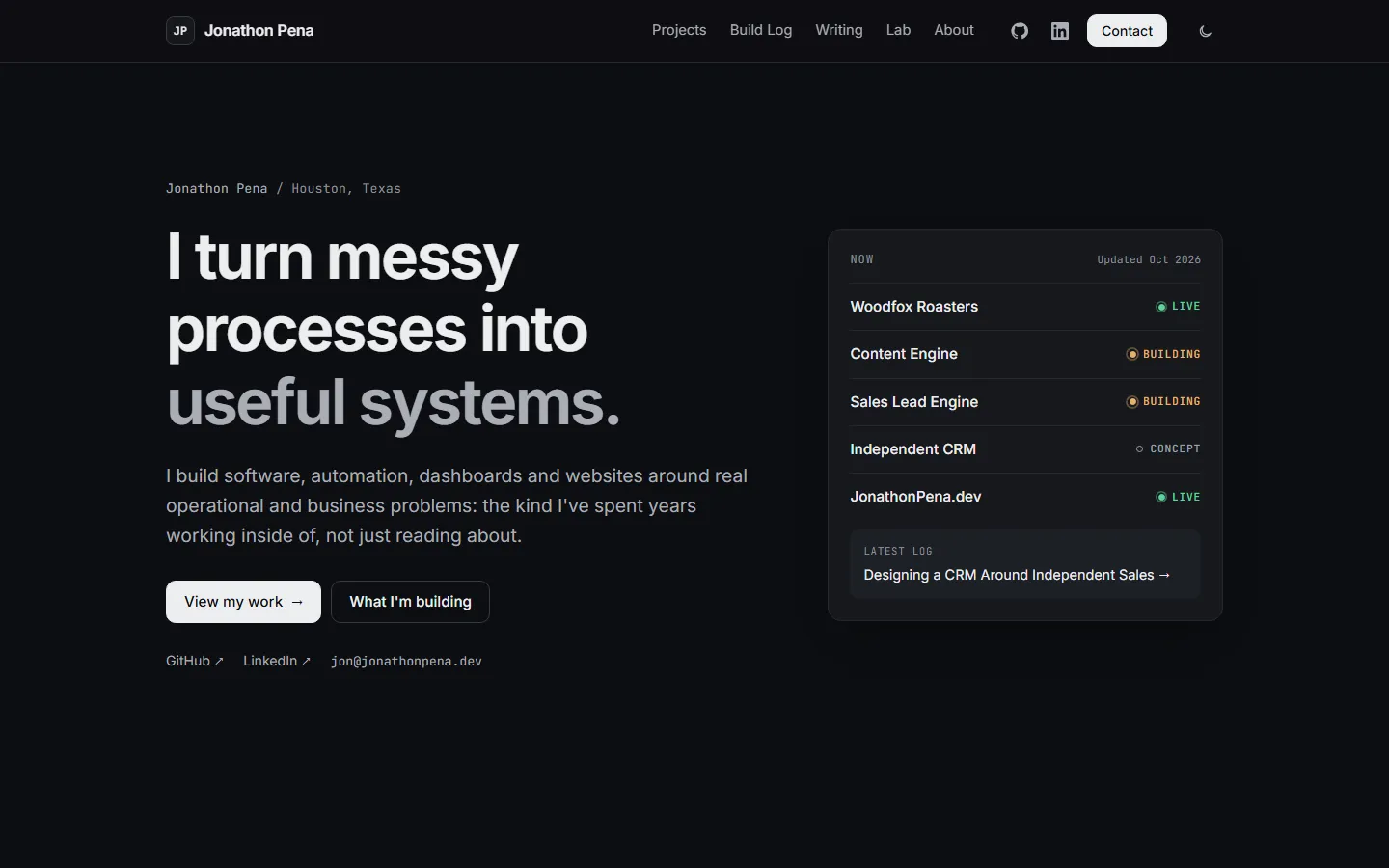
Most personal portfolios turn into static resumes: a hero, three project cards, a contact button, and no reason to come back.
I wanted mine to work more like a living record. Projects show the major work, the Build Log shows progress as it happens, Writing holds what I’ve learned, and the Lab is a place to publish small experiments without pretending each one is a startup.
The first version of this site was a single HTML page. It listed tools instead of showing work, and every change meant editing markup by hand. That’s fine for a business card. It doesn’t work as a home base for ongoing projects.
Make the site content-driven, so publishing is cheap:
And make status explicit. Every project carries one of Live, Building, Prototype, Experiment or Concept, so visitors can see what is shipped and what is still being figured out.
Astro builds static HTML at deploy time. Markdown files in src/content/ become pages, and GitHub Actions builds and deploys to GitHub Pages on every push to main. Interactive pieces ship only the small amount of JavaScript they need.
No framework runtime on the client, self-hosted variable fonts, responsive images generated at build time and lazy-loaded below the fold. Animations are CSS-only, never block content, and switch off when the visitor prefers reduced motion.
Writing the case-study template forced me to answer the same questions for every project: what was the problem, what actually exists, what’s next. It’s a useful discipline beyond the website.
Build log
Replaced a one-page static site with a content-driven site built around projects, a build log, writing and experiments.
Build something
An idea, a messy workflow, a site that should work better. If it's a real problem, I'd like to hear about it.